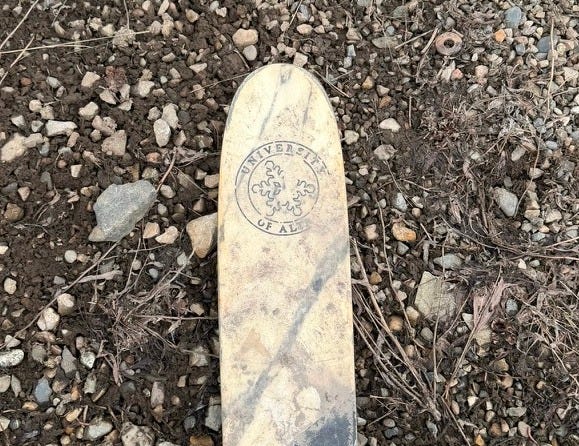
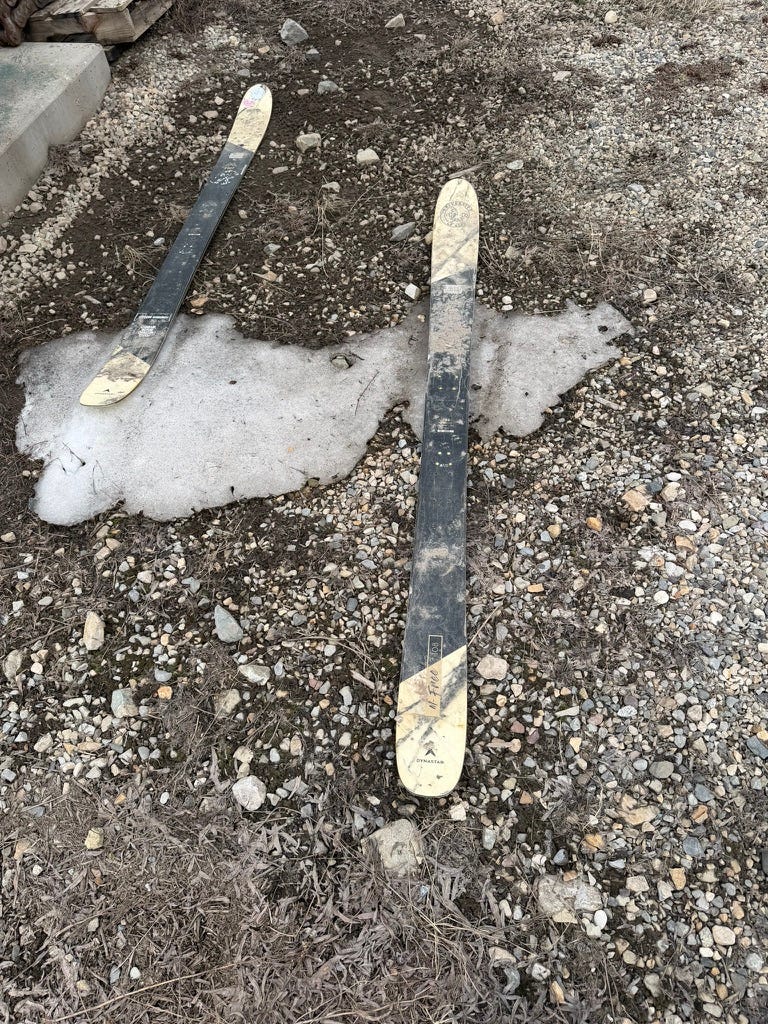
There is a pair of skis sitting under the Wildcat lift at Alta. They have no bindings. They are beat to hell — yellowed, weathered, the kind of condition that would make any ski shop tech wince. The top sheet carries a circular seal in the style of a university crest: University of Alta.
I spotted them on one of my first spring thaw walks in the Albion basin this year. I assumed they were trash. Abandoned gear that someone had never come back for, left to sit through springs and summers until they finally got hauled away.
I came back a few days later and asked a staff member what the deal was.
The answer stopped me.
“Those are the Lucky Skis.”
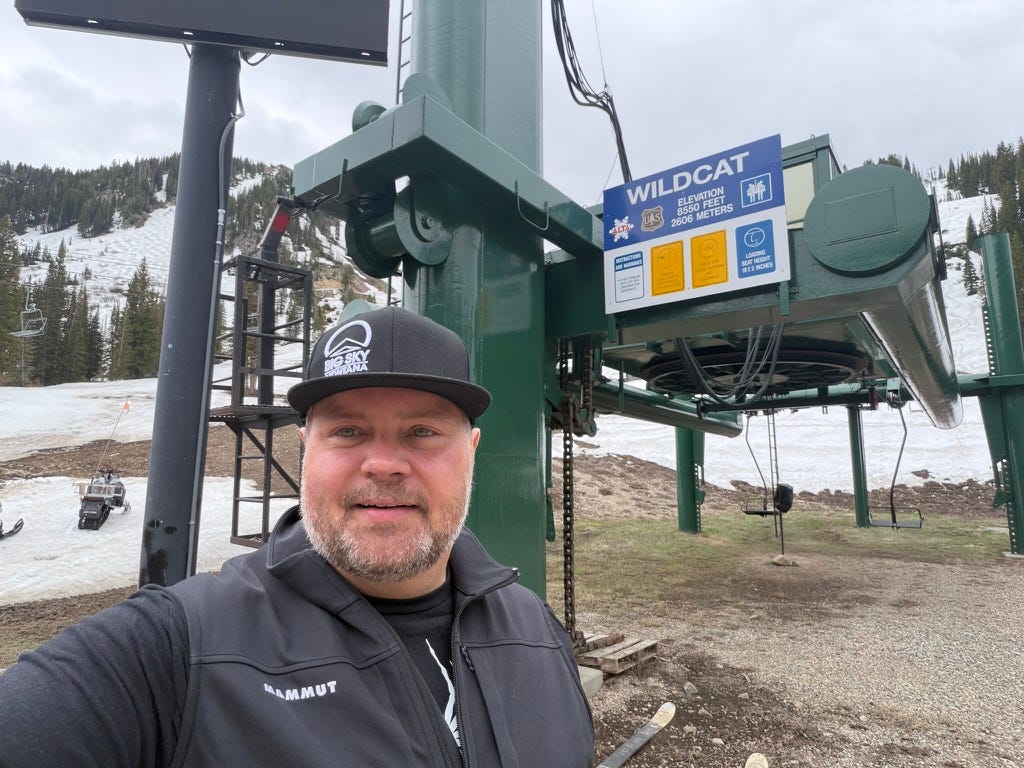
They sit under the Wildcat lift every offseason. They stay there through the summer storms and the September cold snaps and the first dusting of October. They are there when the snowpack starts to build and they are there when the lifts start spinning. The staff member who told me about them said it with the kind of casual reverence you use when you’re describing something that has always been true — not a quirky tradition, just the way things work.
According to lift lore, those skis are responsible for the 900-inch season.
Nine hundred inches. That is the number that lives in the Alta mythology the way certain box scores live in sports mythology. If you ski Alta, you know about the 900-inch year. You have thought about what it would mean to be there for it. You have imagined the snowpack, the sustained cold, the week after week of accumulation.
The Lucky Skis did that.
The staff member paused, then added — with a smile that contained some real rueful humor — that after the season we just had, it might be time to find a new pair.
I have thought about this more than I probably should.
There is something deeply right about the Lucky Skis existing. Alta is the kind of place that inspires a level of devotion that borders on religious. People talk about it in the hushed, reverent register normally reserved for places of genuine spiritual significance. It is not just a resort, It is a temple. And temples have rituals.
Skiers as a population run hot on superstition. Two clicks of your poles before sending it. Pre-run playlists. The ritual hot sauce on the lift before a big run (I see you Rise and Alpine). two beers buried in the snow at the edge of the woods (Stealing one of those beers give you two seasons of low snow). These are not unusual. These are part of the practice.
What I did not expect was to discover that the mountain itself is running the same play.
Alta has a talisman. It is a pair of beat-up, bindingless skis with a great logo under the Wildcat lift. It has been there, doing its job, for longer than most people who tell the tale of its origins have been skiing.
I have a photo of them. The logo is clean enough that I am currently working on lifting it for a die-cut sticker, because it is one of the better pieces of visual identity I have run across in skiing. If it works out, I will let you know.
The mountain is superstitious. The mountain has lucky gear. The mountain has a talisman that it credits with the best snow year in its history.
That tracks. That tracks completely.
If you ski Alta, look for them next time you ride Wildcat. They’ll be there somewhere.
What are your superstitions or traditions? Comment and Subscribe for more.
A note on sourcing: I cannot independently verify the Lucky Skis story. I have no documentation, no sworn affidavit, and no peer-reviewed study confirming that a pair of bindingless skis beneath a chairlift is responsible for a 900-inch snow year. What I have is a lift operator at Alta who told me with complete conviction, and that is frankly more than enough. I have chosen to accept this as fact, repeat it as fact, and take the consequences of a bad snow year personally — as in, if the skis don't work this season, I will be filing a formal complaint with whoever is in charge of Alta's talisman program.
This is the correct response to mountain folklore and I will not be argued out of it.
